








-
- Posted by AEPO-ARTIS
AEPO-ARTIS “Acting Fairly?” report finds EU copyright rules still do not deliver fair remuneration for actors
Brussels, 5 May 2026 AEPO-ARTIS announces the publication of “Acting Fairly?”, a new report assessing the impact of Chapter 3 of the Copyright in the Digital Single Market (CDSM) Directive...

-
- Posted by AEPO-ARTIS
Performers on the agenda of the EU Japan IPA
On April 27 and 28, AEPO-ARTIS participated in Tokyo in a conference on AI and IP, organised within the framework of the EU-Japan IP Action project. The IPA project focusses...
-
- Posted by AEPO-ARTIS
European Parliament adopts INI-report “Copyright and generative artificial intelligence – opportunities and challenges”
On 10 March the European Parliament adopted with a large majority the INI-report “Copyright and generative artificial intelligence – opportunities and challenges” as approved by the JURI Committee earlier this...

-
- Posted by AEPO-ARTIS
AEPO-ARTIS “Acting Fairly?” report finds EU copyright rules still do not deliver fair remuneration for actors
Brussels, 5 May 2026 AEPO-ARTIS announces the publication of “Acting Fairly?”, a new report assessing the impact of Chapter 3 of the Copyright in the Digital Single Market (CDSM) Directive...

-
- Posted by AEPO-ARTIS
Performers on the agenda of the EU Japan IPA
On April 27 and 28, AEPO-ARTIS participated in Tokyo in a conference on AI and IP, organised within the framework of the EU-Japan IP Action project. The IPA project focusses...
-
- Posted by AEPO-ARTIS
European Parliament adopts INI-report “Copyright and generative artificial intelligence – opportunities and challenges”
On 10 March the European Parliament adopted with a large majority the INI-report “Copyright and generative artificial intelligence – opportunities and challenges” as approved by the JURI Committee earlier this...
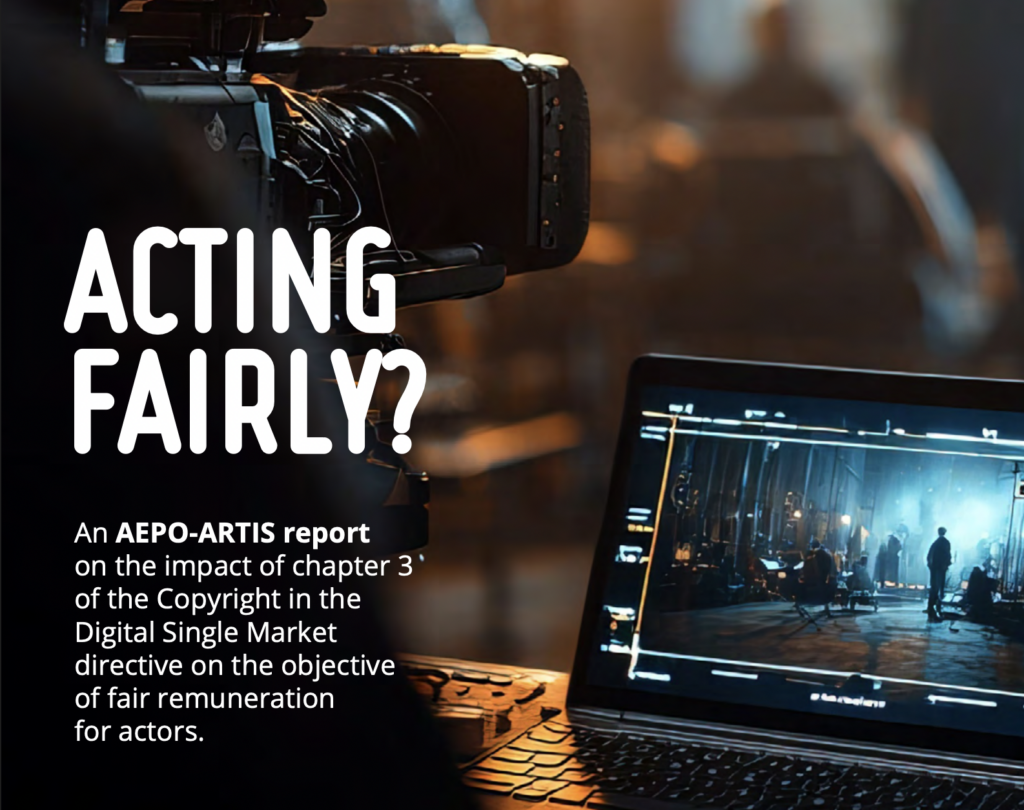
An AEPO-ARTIS report on the impact of chapter 3 of the Copyright in the Digital Single Market directive on the objective of fair remuneration for actors.
Acting Fairly?
“Acting Fairly?” is a new report assessing the impact of Chapter 3 of the Copyright in the Digital Single Market (CDSM) Directive on the fair remuneration of actors. The report is based on a survey completed by 2,382 professional actors across 11 EU Member States, making it the most extensive analysis of contractual practices affecting actors since the entry into force of the CDSM Directive.
When the CDSM Directive was adopted in 2019, it recognised that performers are often in a weaker contractual position when they transfer or license their rights. It therefore introduced a specific chapter on fair remuneration, including the principle that performers are entitled to “appropriate and proportionate remuneration”, as well as additional rights to transparency, contract adjustment, alternative dispute resolution and rights revocation.
Seven years later, the findings of “Acting Fairly?” show that – for actors – these provisions have not achieved their objective.
The report is available on this link.
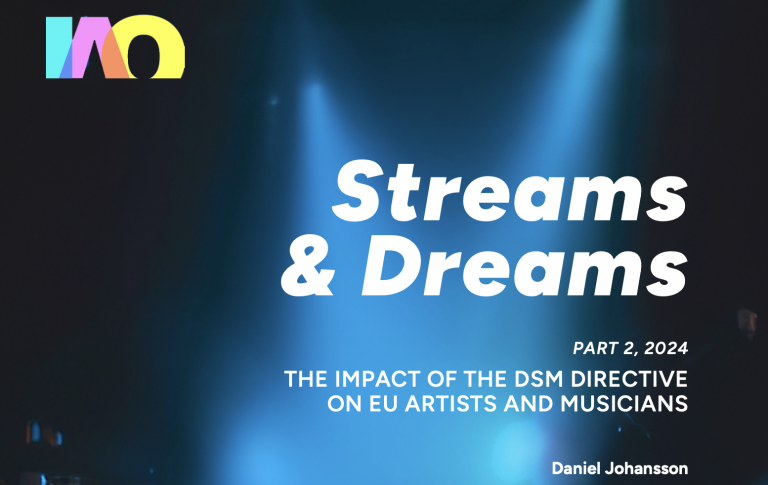
Streams & Dreams Part 2
A report entitled Streams & Dreams Part 2 – The Impact of the DSM Directive on EU Artists and Musicians, written by the independent music business researcher Daniel Johansson (Inland Norway University of Applied Sciences) and published on June 13th 2024, proves the ineffectiveness of the DSM Directive.
Based upon a survey of 9.542 artists from 19 EU countries, conducted by AEPO-ARTIS and its members in collaboration with IAO, this is one of the most substantiated reports ever done on issues related to performers in the music industry.
The report is available here.
We defend performers’ rights
Objectives
As the paramount voice of performers’ collective management organisations in Europe, the main objectives of AEPO-ARTIS are to develop, strengthen and protect performers' rights as well as to highlight the contribution that performers make to Europe’s rich and diverse cultural sector.
Members
The members of AEPO-ARTIS are among the most experienced organisations in Europe working with actors, musicians, dancers and other performers. They have all been founded by performers, for performers with the aim of collectively managing their neighbouring rights.
Our 42 member organisations represent more than 650,000 performers.